From the drawer
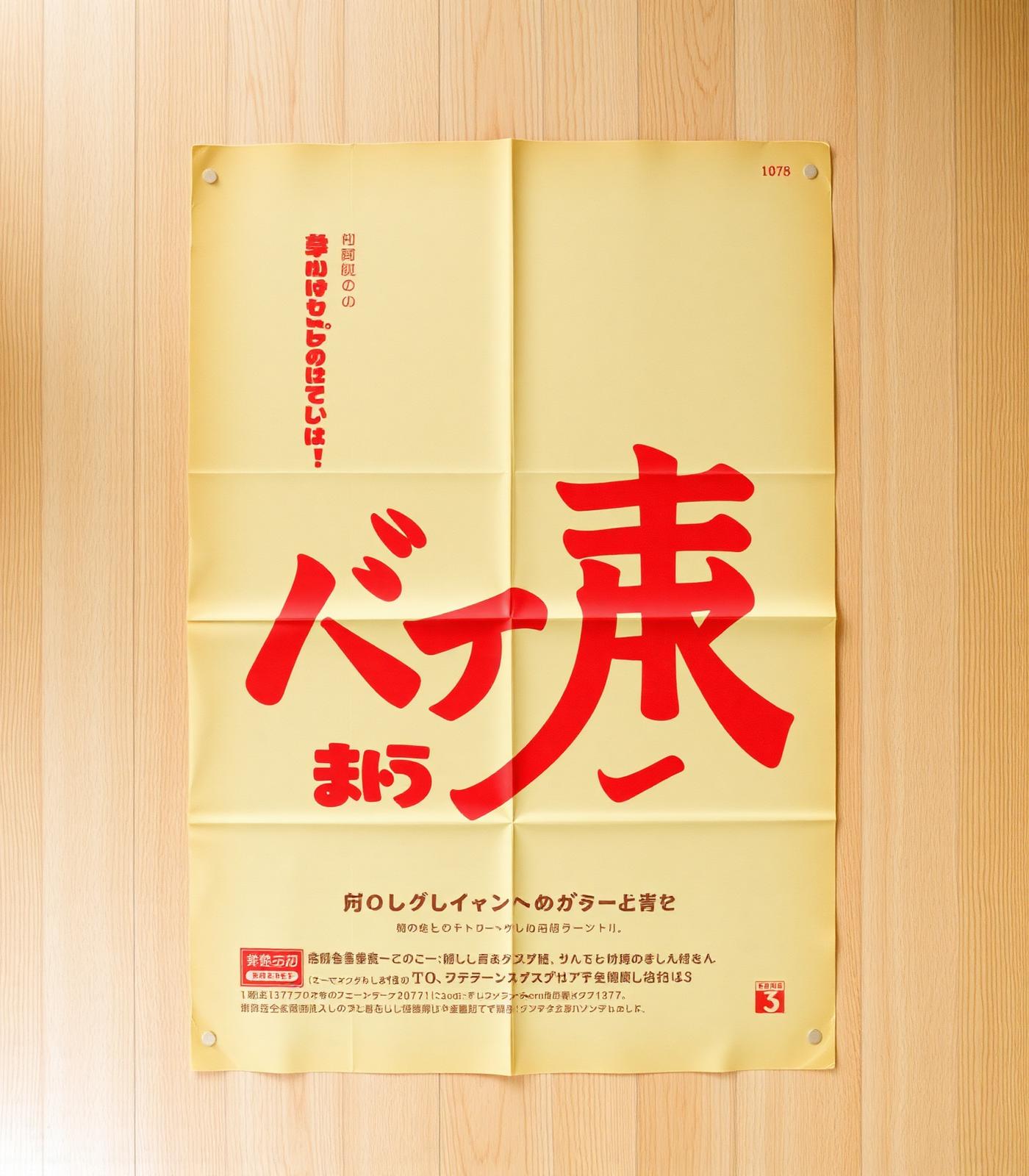
Original release, unrestored. The fold marks are the point.
A folded poster.
An original Japanese film poster from the late 1970s. Kept flat for eighteen years, unfolded perhaps a dozen times, never framed.
Paper.
The paper is not what would be used now. It is heavier than modern poster stock, slightly warmer in tone, and the surface has a small resistance — you can feel the fibres if you run a thumb along the edge. Someone chose this paper on purpose, forty-eight years ago. Someone who is probably no longer alive.
Printing.
On the specific red of the ink — not a red available in any standard press profile today — and on the small halo where the colour has migrated a hair into the paper. This is what people mean when they say old print looks alive.
Fold marks.
There are four folds — two horizontal, two vertical — and the paper has softened along all of them. The temptation, of course, is to have it restored, flattened, mounted behind museum glass. We have chosen not to. The folds are a before it reached us — the shop counter, the cardboard tube, the sea crossing, someone else’s wall for possibly a decade, someone else’s drawer for another two.
“The folds are not damage. They are the biography.”
Travelling.
The poster was bought in a small market on a Sunday morning in Tokyo. It travelled home in a cardboard tube that itself is now kept, though it holds nothing.
Memory.
On the way certain objects seem to hold the entire trip they arrived on. Opening the drawer opens the Sunday morning; the vendor who spoke almost no English and did not need to; the exact price, in yen, still written in pencil on the reverse.
History.
We have never looked up what the poster would sell for. We do not want to know. Introducing a market value would displace the actual value, which is not transferable and cannot be indexed.
“Some survive not because they are valuable. They become valuable because someone continued choosing not to let them disappear.”
Elsewhere in this issue
The Long Afternoon